

Q-Chem 한국 판매처입니다.
크라이스아이앤씨는 Q-Chem 한국 공인 리셀러/로서 국내 기업, 학교, 연구기관 및 개인 고객을 대상으로 큐캠라이선스를 공급하고 있습니다. Q-Chem 라이선스 종류와 가격, 구매 방법에 대한 문의 및 견적 상담이 가능합니다. 다양한 소프트웨어 제품은 소프트웨어 제품 목록에서 확인하실 수 있습니다.
가격 및 구매 안내
| 제품명 | 가격(VAT포함) |
|---|---|
| Q-Chem 7.0 only (Permanent), Commercial, Single Seat, Single Research Group, No BrianQC: Base License | 15,840,000원 |
COACH Functional
COACH is a new range-separated hybrid (RSH) meta-GGA functional that is more accurate and generally transferable than the best existing RSH meta-GGAs,
such as ωB97M-V.
Linear Scaling via Local Correlation
Q-Chem 7 includes a new linear-scaling local correlation algorithm for MP2 and double-hybrid DFT!
It is faster and more accurate than DLPNO, and it uses a single numerical threshold, making it easy to tune accuracy.
More Cutting-Edge DFT Features
- Ongoing performance improvements, including RI speedup and MPI
- “Robust SCF” for improved convergence
- New complex-variable functionals
- Complex absorbing potentials (CAP-DFT
Black-Box “Robust SCF” Procedure
More robust SCF and DFT convergence, including automatic detection and correction of incipient SCF divergence and algorithm switching. This approach will be valuable in big-data applications and will assist with difficult-to-converge cases.
MRSF-TDDFT
Mixed reference spin-flip TDDFT including energies, properties with SOC, and wavefunction analysis.
New Analysis Tools
A new charge-transfer metric for TDDFT in libwfa.
These metrics are rigorously invariant with respect to orbital rotations, unlike earlier metrics such as Tozer’s Lambda, and metrics widely used in the Gaussian program.
Energy decomposition analysis (EDA) can be used to decompose the energy into physically-meaningful components, and now includes ROKS-EDA, EDA OVOCV analysis, and force decomposition analysis (FDA).
Linear Scaling via Local Correlation
Q-Chem 7 includes a new linear-scaling local correlation algorithm for MP2 and double-hybrid DFT! It is faster and more accurate than DLPNO and uses a single numerical threshold, making it easy to tune accuracy.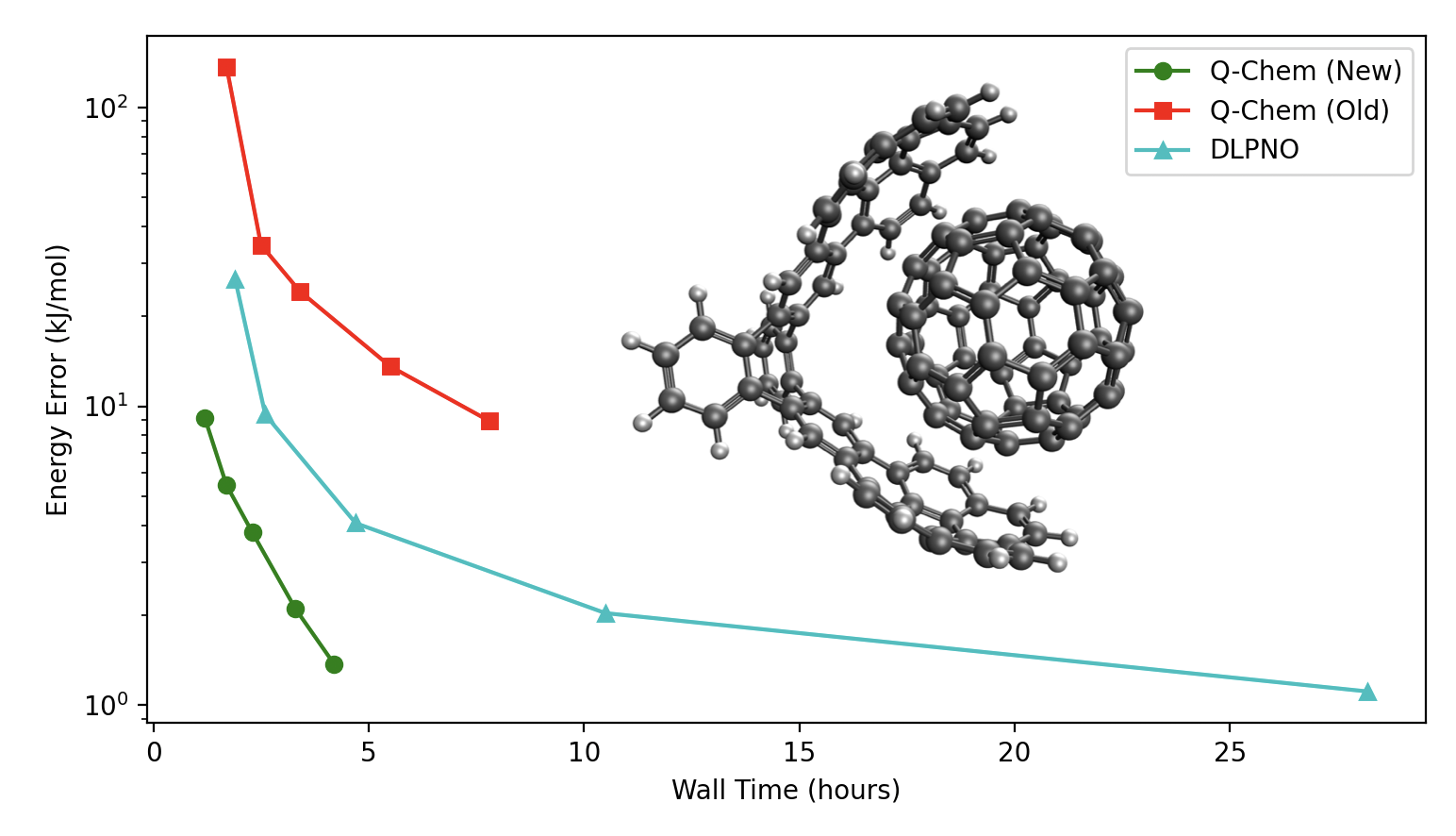
Comparison of interaction energy error and compute time between Q-Chem’s regular MP2, the new LMP2 available in Q-Chem 7, and DLPNO-MP2.
MRSF-TDDFT
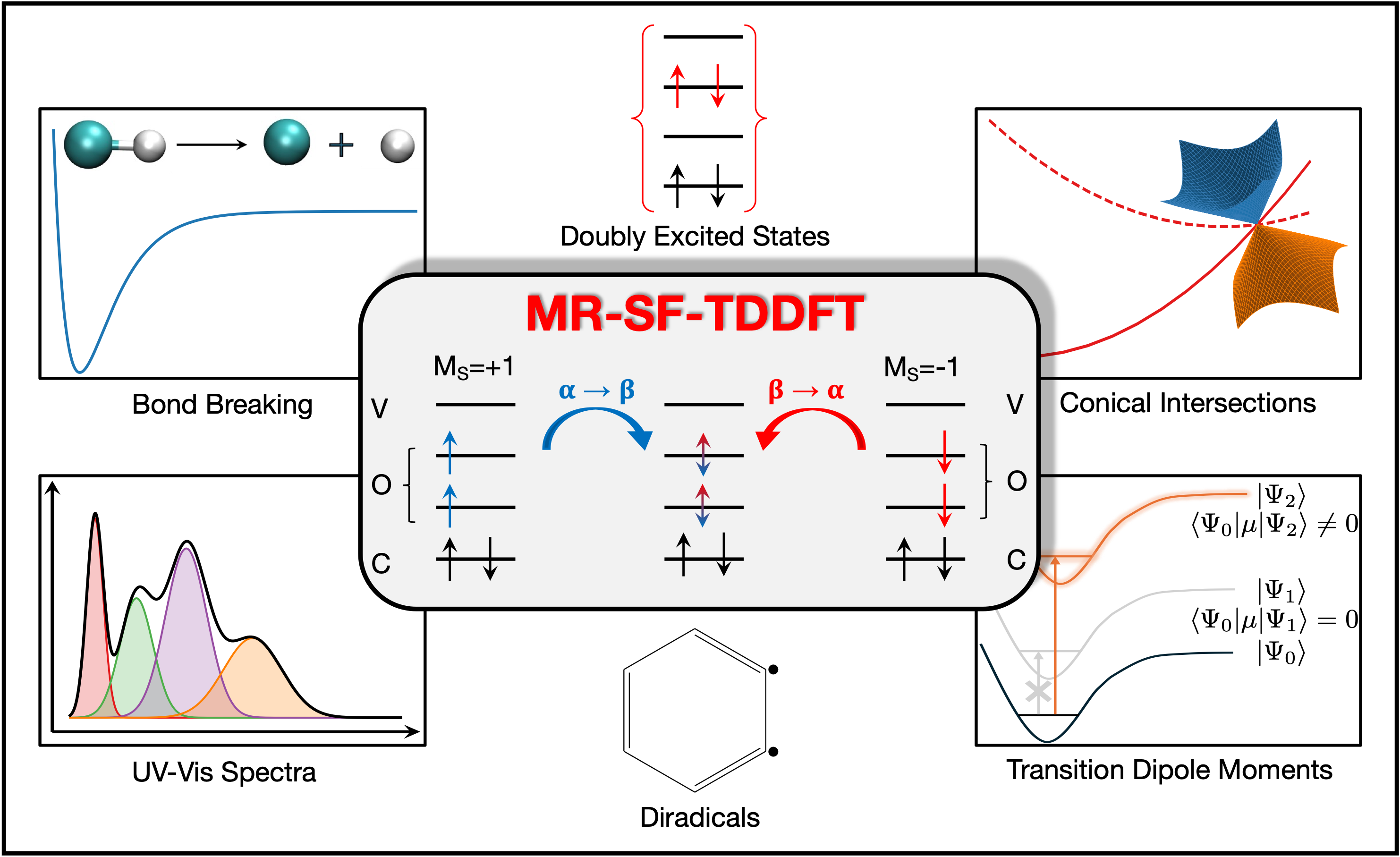
MRSF-TDDFT is an improved version of spin-flip TDDFT that enables effectively spin-pure treatments of doubly excited states, bond-breaking, conical intersections, and some other cases of strongly correlated systems. Q-Chem 7 presents effective MRSF-TDDFT implementation including calculation of state and transition properties, such as state and transition dipole moments, oscillator strengths, spin–orbit couplings, and density-matrix based analyses of the MRSF states and transitions. Read the paper here.
New Features in Q-Chem 7
Q-Chem 7 is now available! Q-Chem 7 includes all of the performance and usability features you’ve come to expect from Q-Chem (like our parallel RI algorithms for fast DFT performance, and our Robust SCF algorithm for easy convergence), along with a plethora of new features.
Review some of our highlighted features below! You can also view the release log here for a full list of features, improvements, and bugfixes.
QC-PBC
QC-PBC is a new module for handling solid-state systems and materials by all-electron calculations with periodic boundary conditions and Gaussian basis sets. Click here for more information!
- DFT and TDDFT
- MP2, LT-MP2, and MP3 for gamma and k-point calculations
- CCSD, CCSD(T), and CCSDT for gamma-point calculations
- Python interfacing
- Geometry optimization
- Solvation
- Analytic frequency and phonon calculations
M-Chem
M-Chem (scheduled to be released later in July) is a new module for handling large biomolecular systems. Learn more here!
- High-performance MPI/OpenMP hybrid implementation for molecular dynamics (MD) simulations
- Fixed charge (Amber), polarizable (AMOEBA), and ReaxFF force fields
- Nose-Hoover thermostat and barostats, conjugate gradient self-consistent field and novel extended Lagrangian schemes for solving the many-body forces, periodic boundary conditions, and particle mesh Ewald
- Modular front-end that stream-lines parameter assignment and system preparation in a more user-friendly and reproducible way for standard force fields and protein-water simulations
- QM/MM integration with ReaxFF
- Trajectory formats for analysis in other codes
Density Functional Theory
- COACH functional: A new range-separated hybrid (RSH) meta-GGA that is more accurate and transferable than the best existing RSH meta-GGAs, such as ωB97M-V, for a wide variety of systems. (Jiashu Liang, Martin Head-Gordon)
- Faster MP2 and double-hybrid DFT: New algorithm provides competitive scaling with DLPNO for MP2 and double-hybrid DFT, with improved error control for higher accuracy. (Zhenling Wang, Yao Shen, Martin Head-Gordon)
- ECD with TDDFT (Xunkun Huang, WanZhen Liang) and EOM-CCSD
- New complex-variable DFT functionals for handling electronically metastable states, including LDA (Slater X, VWN5 C, VWN1RPA C), GGA (B88 X, PBE X, PBE C, LYP C) and hybrid (all hybrid functionals composed of the above LDAs and GGAs and possibly exact HF exchange, including PBE0, B3LYP and BH&HLYP). (Charlotte Titeca, Yifan Jiang, Thomas-C. Jagau)
- Extended tight binding DFT (xtb) energy and gradient (Rebecca Tomann, Siyavash Moradi, Lucas de Kam, Christopher Stein, Martin Head-Gordon)
Correlated Methods
- MRSF-TDDFT with properties: MRSF-TDDFT is an improved version of spin-flip TDDFT that enables effectively spin-pure treatments of doubly excited states, bond-breaking, conical intersections, and some other cases of strongly correlated systems. Q-Chem 7 presents effective MRSF-TDDFT implementation including calculation of state and transition properties, such as state and transition dipole moments, oscillator strengths, spin–orbit couplings, and density-matrix based analyses of the MRSF states and transitions. (Arnab Chakraborty, Zheng Pei, Yihan Shao, Anna I. Krylov)
- New excited-state analysis features based on Earth Mover’s Distance (Zhe Wang, Martin Head-Gordon)
- Charge-displacement metrics of TDDFT in libwfa. These metrics are rigorously invariant with respect to orbital rotations, unlike earlier metrics used in other software packages (John Herbert)
- Large speedups in RI-CC2 ground state code in libgmbpt (Hrishikesh Ram and Martin Head-Gordon)
- CC2 and RI-CC2 Dyson orbitals for EA, IP, EE-EA, and EE-IP (Mauro Gascón Navas, Thomas C. Jagau, Robin E. Moorby, Simen Camps, Tianyi Gao)
- THC-sRI Improvements: Includes RI-CC2 and sRI-CC2 oscillator strengths; THC-sRI-CC2 ground and excited state energies and properties; and THC-sRI-CCSD ground and excited state energies (Chongxiao Zhao, Ruihao Bi, Qi Ou, Joohno Lee, Chenyang Li, Wenjie Dou)
- Performance improvements for RI and CD CCSD and EOM-CCSD
- New tools for calculating Auger decay rates using CC/EOM-CC
- NMR chemical shifts improvements (Xiao Liu, Martin Head-Gordon)
- New MPI/OpenMP parallel finite first differences algorithm using RI gives very large speedups over Q-Chem’s legacy NMR code
- Support for all modern density functionals through hybrids
Molecular Dynamics, Non-adiabatic Dynamics, Embedding, and Solvation
- New embedding interface for external packages like CP2K (Ar Fonlon, Elena Kolodzeiski, Dustin R. Broderick, Kay Carter-Fenk, Christopher J. Mundy, Christopher J. Stein, John M. Herbert)
- An order of magnitude total speed up for large QM/EFP jobs via parallelization of one-electron integrals (Lyudmila Slipchenko)
- Pairwise harmonic confiner for optimization in internal coordinates (Chance Brandt, John Herbert)
Fragment and Energy Decomposition Analysis
- Correlated wavefunction EDA: EDA-II is available for MP2, BW-s2, κ-MP2 using the linear-scaling codebase (Zhenling Wang, Hengyuan Shen, Martin Head-Gordon)
- EDA OVOCV analysis and OODFT OVOCV analysis: OVOCV can be used to replace or complement NOCV analysis in EDA; it provides clearer identification of donor and acceptor orbitals than NOCV methods. (Hengyuan Shen, Martin Head-Gordon)
- Two new MBD dispersion models for XSAPT+MBD:
- MBDrev, based on machine learning applied to the SAPT10k data set (Corentin Villot and Ka Un Lao)
- oC8raim, with improved performance for ions and extended to heavy elements (Keegan Paice, John Herbert)
Incorporation of Quantum Nuclear Effects (NEO Suite)
- NEO-AIMD methods for NEO-HF and NEO-DFT, including:
- NEO Born-Oppenheimer MD (NEO-BOMD) (Joseph Dickinson, Sharon Hammes-Schiffer)
- Extended Lagrangian MD (NEO-ELMD) (Joseph Dickinson, Sharon Hammes-Schiffer)
- Constrained NEO MD (CNEO-MD) (Joseph Dickinson, Sharon Hammes-Schiffer)
- NEO-PCM and NEO-QM/MM (Joseph Dickinson, Sharon Hammes-Schiffer)
Tey Q-Chem
IQmol
IQmol is Q-Chem’s free, open-source molecular editor and visualization package. Use our server to run short Q-Chem jobs!
Try Q-Chem https://www.iqmol.org
Q-Cloud
No hardware? No problem!
Use Q-Cloud to easily run calculations on AWS servers in the cloud.
Free Demo
Request a free demo license, no strings attached!
https://www.q-chem.com/try
Execution Environment
Q-Chem is shipped as a single executable along with several scripts. No compilation is required. Once the package is installed it is ready to run. Please refer to the installation notes for your particular platform, which are distributed with the software. The system software required to run Q-Chem on your platform is minimal, and includes:
A suitable operating system.
Run-time libraries (usually provided with your operating system).
Please check the Q-Chem web site (www.q-chem.com) or contact Q-Chem support (support@q-chem.com) if further details are required.
Hardware Platforms and Operating Systems
Q-Chem runs on a wide variety of computer systems, ranging from Intel and AMD microprocessor-based PCs and workstations, to high-performance server nodes used in clusters and supercomputers. Q-Chem supports the Linux, Mac, and Windows operating systems. To determine the availability of a specific platform or operating system, please contact support@q-chem.com.
Memory and Disk Requirements
Memory
Q-Chem, Inc. has endeavored to minimize memory requirements and maximize the efficiency of memory usage. Still, the larger the structure or the higher the level of theory, the more memory is needed. Although Q-Chem can be run successfully in very small-memory environments, this is seldom an issue nowadays and we recommend 2 GB per CPU core as a minimum. Q-Chem also offers the ability for user control of important, memory-intensive aspects of the program. In general, the more memory your system has, the larger the calculation you will be able to perform.
Q-Chem uses two types of memory: a chunk of static memory that is used by multiple data sets and managed by the code, and dynamic memory which is allocated using system calls. The size of the static memory is specified by the user through the $rem variable MEM_STATIC and has a default value of 192 MB.
The $rem variable MEM_TOTAL specifies the limit of the total memory the user’s job can use. The default value is sufficiently large that on most machines it will allow Q-Chem to use all the available memory. This value should be reduced on machines where this is undesirable (for example if the machine is used by multiple users). The limit for the dynamic memory allocation is given by (MEM_TOTAL − MEM_STATIC). The amount of MEM_STATIC needed depends on the size of the user’s particular job. Please note that one should not specify an excessively large value for MEM_STATIC, otherwise it will reduce the available memory for dynamic allocation. Memory settings in CC, EOM, and ADC calculations are described in Section 6.17. The use of $rem variables will be discussed in the next Chapter.
Disk
The Q-Chem executables, shell scripts, auxiliary files, samples and documentation require about 1.4GB of disk space, depending on the platform. The default Q-Chem output, which is printed to the designated output file, is usually only a few kilobytes. This will be exceeded, of course, in difficult geometry optimizations, QM/MM and QM/EFP jobs, as well as in cases where users invoke non-default print options. In order to maximize the capabilities of your copy of Q-Chem, additional disk space is required for scratch files created during execution, and these are automatically deleted upon normal termination of a job. The amount of disk space required for scratch files depends critically on the type of job, the size of the molecule and the basis set chosen.
Q-Chem uses direct methods for Hartree-Fock and density functional theory calculations, which do not require a large amount of scratch disk space. Wave function-based correlation methods, such as MP2 and coupled-cluster theory, require substantial amounts of temporary (scratch) disk storage, and the faster the access speeds, the better these jobs will perform. With the low cost of disk drives, it is feasible to have between 100 and 1000 GB of scratch space available as a dedicated file system for these large temporary job files. The more you have available, the larger the jobs you will be able to run. In the case of some jobs, like MP2, the jobs will also run faster as two-electron integrals are computed less often.
[Q-Chem 견적 요청]

Q-Chem 한국 판매처 및
공인 리셀러
주식회사 크라이스아이앤씨는 2003년에 설립되어 Q-Chem 제품을 2019년도부터 판매해오고 있으며, 한국 공인 리셀러 입니다.
크라이스아이앤씨 는 국내 대표적인 IT 소프트웨어공급사로 한국 국내에 기업,학교,연구기관 및 공공기관등 여러 각종 전문분야에 종사하시는 분들에게 맞는 제품을 공급해드리고 있으며, 구매하신 소프트웨어제품의 업데이트와 필요시 업그레이드 지원을 하고 있습니다.
고객들이 해외소프트웨어구매시 어려움이 없게 크라이스아이앤씨 자체쇼핑몰 kreissoft.co.kr 를 운영해오고 있으며 또한 설계,디자인,영상,음악등 엔터테인먼트 분야에 특화된 쇼핑몰 Dez.co.kr 도 같이 운영하고 있습니다.
일반 고객들도 쉽고 편하게 이용할수 있도록 네이버 스마트스토어에 2018년도부터 입점하여 당사가 취급하는 전제품을 올려놓았으며 그동안 고객지원에 힘쓴결과 2022년 네이버파트너 인증을 받았습니다.